
Purpose #
This article describes how to configure AccountingSuite for a Philippine company that is not registered for VAT but buys from VAT-registered suppliers, and needs to compute Withholding Tax (WHT) on the amount exclusive of VAT – as required for BIR Form 2307.
In short: the company does not pay or claim VAT, but the system must still “see” the VAT on purchases in order to derive the correct WHT base (net of VAT).
Configuration Steps #
1. Enable VAT tracking for purchases #
Turn on VAT handling so that VAT can be entered and displayed on purchase documents (Purchase Orders, Bills). This is needed only to establish the net-of-VAT base – the company itself does not remit or claim VAT.
2. Set an empty/default VAT for all customers #
In the default Tax Group for customers, leave the VAT field empty (no VAT) only WHT. Since the company is non-VAT, no output VAT should ever be applied on the sales side.
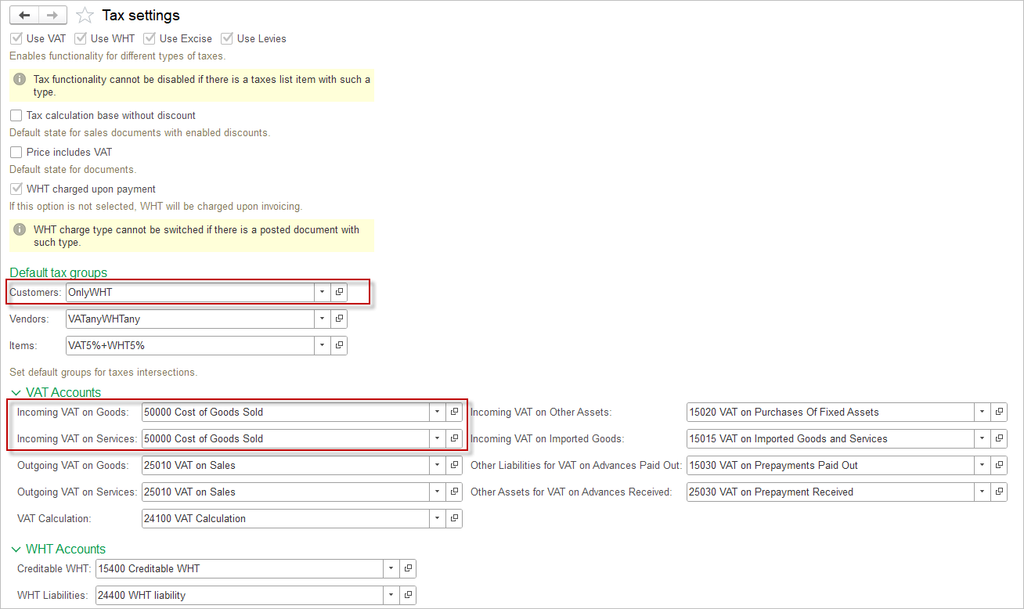
3. Map the Incoming VAT account to COGS #
In the account settings for Incoming VAT, set the posting account to 50000 Cost of Goods Sold.
This ensures the input VAT is not left sitting on a VAT receivable account (which would accumulate an unrecoverable balance), but is instead written off to COGS.
4. Configure WHT with a Net Amount base #
Set up the WHT tax with Calculation Base = Net Amount (i.e., exclusive of VAT). This makes the system compute WHT on the net-of-VAT amount, matching the BIR 2307 requirement.
How It Works (Example) #
Supplier invoice: goods 10,000 · VAT 12% = 1,200 · WHT 1% = 100
| Item | Amount |
|---|---|
| Net price (excl. VAT) | 10,000 |
| VAT | 1,200 |
| WHT base (Net Amount) | 10,000 |
| WHT (1%) | 100 |
- WHT is calculated on 10,000, not on 11,200 – correct for BIR 2307.
- The VAT of 1,200 is posted to
50000 Cost of Goods Soldvia the Incoming VAT account mapping.
Limitation / Known Trade-off #
VAT is not capitalized into the inventory cost of purchased goods. Instead, it is expensed immediately to COGS.
This means that before the goods are sold, the COGS account is overstated by the VAT amount. Once the goods are sold, the total cost recognized (inventory + VAT already expensed) is economically correct, but the timing differs from a strict “VAT included in inventory cost” treatment.
Impact:
- ✅ BIR 2307 base is correct (net of VAT).
- ⚠️ Interim COGS is overstated until the related goods are sold.
- ⚠️ If auditors require VAT to be capitalized into inventory, this configuration will not satisfy that requirement without further customization.
Summary #
| Requirement | Configuration |
|---|---|
| VAT visible on purchases | Enable VAT tracking on purchase documents |
| No output VAT on sales | Empty VAT in default customer Tax Group |
| Input VAT not left as receivable | Incoming VAT account → 50000 Cost of Goods Sold |
| WHT computed on net of VAT | WHT Calculation Base = Net Amount |
| BIR 2307 base correct | ✅ Yes — net-of-VAT amount is used |
This setup is a pragmatic workaround for a rare case. It produces correct WHT and BIR 2307 figures, at the cost of expensing VAT to COGS rather than capitalizing it into inventory.