
Introduction: Why NGOs Need More Than a Standard Accounting System #
Non-governmental organizations (NGOs) and Non-profit organizations (NPOs) operate under fundamentally different accounting principles than for-profit businesses. Instead of maximizing profit and returning value to shareholders, NGOs are built around stewardship of funds, mission fulfillment, and accountability to donors and the public. This changes everything: the structure of financial statements, the concept of “capital,” the classification of revenue, and the way expenses are tracked and reported.
A typical NGO must handle:
- Donor-restricted and unrestricted funds – Contributions must be classified as “with donor restrictions” or “without donor restrictions,” and restricted funds may only be used for specified purposes or periods.
- Fund accounting – Resources are grouped into separate funds (projects, programs, endowments) to track sources and allowable uses, with each fund treated as a mini-entity for internal reporting.
- Functional expense classification – Expenses are categorized by program services, management and general, and fundraising to demonstrate how much goes directly to mission versus support.
- Conditional vs. unconditional grants – Conditional grants with a right of return may need to be recorded as refundable advances (liability) and recognized as revenue only when conditions are met.
- Multiple revenue streams – Contributions, grants, membership dues, program service fees, and sometimes commercial activities (e.g., a coffee shop or clinic) each have their own recognition rules.
When an NGO also operates diverse activities – such as a foundation, a school, a clinic, an employee microfinance scheme, and a coffee shop – the accounting system must be flexible enough to handle each activity’s unique requirements while still producing consolidated reports for the organization as a whole.
This article explains how AccountingSuite addresses these needs through its flexible chart of accounts, configurable tax rules, and extensible architecture, and how the system can be tailored to virtually any NGO structure.
How AccountingSuite Covers Core NGO Requirements #
Flexible Chart of Accounts #
AccountingSuite provides a fully customizable Chart of Accounts that can be structured to mirror the NGO’s fund structure. Each fund, project, or activity can have its own set of accounts, or accounts can be shared with dimensions/classes to track funds across the organization. This supports:
- Fund accounting – Create separate account ranges for each donor-restricted fund, program, or endowment.
- Activity-based tracking – Use classes, locations, or custom dimensions to track revenue and expenses by activity (Foundation, School, Clinic, Microfinance, Coffee Shop).
- Consolidated reporting – Despite separate tracking, AccountingSuite can generate consolidated financial statements across all activities.
Tax Rule Configuration #
NGOs often enjoy tax exemptions, but these come with strict compliance requirements. AccountingSuite allows you to:
- Configure multiple tax rates (VAT, Withholding Tax, etc.) per jurisdiction.
- Set up tax-exempt status for specific funds or activities.
- Handle conditional grants and deferred revenue through liability G/L accounts.
- Support multi-currency transactions, essential for NGOs receiving foreign grants.
Donor and Project Tracking #
AccountingSuite’s Project and Job costing capabilities allow you to:
- Track budgets vs. actuals by donor, project, or grant.
- Monitor restricted fund balances.
- Generate donor-specific financial reports.
User Permissions and Segregation of Duties #
With support multi-users work, AccountingSuite enables role-based access:
- Accountants – Full access to GL, reporting, reconciliation.
- Program managers – Access to their project budgets and expenses.
- Clinic/school staff – Limited access to income and expense entry.
- Management – Dashboards and consolidated reports.
Activity-Specific Considerations and How AccountingSuite Supports Them #
1. Foundation Activities #
Typical requirements: Donor-restricted funds, endowment management, grant tracking, compliance with charitable purpose.
AccountingSuite approach:
- Create separate funds as Classes or account segments.
- Track restricted vs. unrestricted net assets.
- Generate statements of activities and financial position in line with NGO reporting standards.
- Use Custom fields to record donor restrictions and grant conditions.
2. School #
Typical requirements: Tuition fees, scholarships, payroll for teachers, educational supplies, parent communications.
AccountingSuite approach:
- Accounts Receivable for student fees, with aging reports.
- Payroll module for staff salaries and benefits.
- Inventory for textbooks and supplies.
- Custom invoicing for tuition and fees.
- Integration with student information systems (front-office) via customization or third-party integration.
3. Clinic #
Typical requirements: Patient billing, insurance claims, medical supplies inventory, doctor fees, regulatory compliance.
AccountingSuite approach:
- Sales and invoicing for patient services.
- Inventory management for medicines and supplies (with lot tracking if needed).
- Expense tracking by department or service line.
- Custom reporting for healthcare metrics.
- Integration with electronic health records (EHR) or practice management software through custom extensions.
4. Small Microfinance Scheme for Employees #
Typical requirements: Loan disbursement, repayment schedules, interest calculation, employee payroll deductions.
AccountingSuite approach:
- Loans Receivable and Loans Issued account with sub-ledger for each employee.
- Amortization schedules and automatic repayment postings.
- Integration with Payroll for automatic deductions.
- Custom reports for loan portfolio aging and delinquency.
5. Coffee Shop #
Typical requirements: Sales, inventory (beans, milk, supplies), cost of goods sold, point-of-sale integration.
AccountingSuite approach:
- Inventory with recipe/BOM (bill of materials) for menu items.
- POS integration via API or third-party connector.
- Sales tax configuration (if applicable).
- Daily sales reconciliation and Cash management.
6. Bible Society (Livestock, Dairy & Cheese Production) #
Typical requirements: Donor-funded agricultural operations (cattle, sheep), milk production, cheese processing, and potential use of specialized farm management software for livestock tracking and milk quality monitoring.
AccountingSuite approach:
Livestock as Assets – Asset Management Module
AccountingSuite’s Asset Management module supports the full asset life cycle – acquisition, depreciation/amortization, and disposal – and is designed to handle multiple asset types within a single document. For the Bible Society’s livestock operations:
- Cattle and Sheep as Fixed Assets: Each animal (or animal group) can be registered as a fixed asset with acquisition cost, useful life, and optional salvage value. The system supports both immediate capitalization to the Chart of Accounts and acquisition through the Item (Product) workflow for more granular control.
- Depreciation Schedules: While livestock is typically not depreciated in the traditional sense under IAS 41 (biological assets are measured at fair value less costs to sell), the Asset Management module can still be used to track the book cost of animals for internal management purposes, especially if the organization follows a cost-based accounting policy for biological assets. Depreciation documents can be created for specific asset groups, with the system calculating charges on a daily basis regardless of the frequency setting.
- Disposal and Sales: When animals are sold, the Disposal document handles the write-off, with automatic calculation of outstanding depreciation between the last depreciation date and the disposal date. For livestock sales, this can be paired with the Sales Invoice module.
Milk and Cheese – Inventory and Production
Milk harvested from dairy cattle or sheep is classified as agricultural produce under IAS 41, measured at fair value less costs to sell at the point of harvest. AccountingSuite can track this through:
- Inventory Management: Milk can be recorded as an inventory item upon harvest, with fair value at harvest becoming the “cost” for inventory purposes.
- Bill of Materials (BOM) / Assembly: For cheese production, the Assembly functionality can be used to track the conversion of milk into cheese, with milk as a raw material component and cheese as the finished product. This mirrors the “products that are the result of processing after harvest” classification in IAS 41.
- Cost Tracking: All input costs (feed, veterinary care, labor) can be allocated to livestock or dairy operations through the Chart of Accounts and project/class tracking.
Integration with Specialized Front-Office Software
For the Bible Society’s livestock and dairy operations, the organization may already use or wish to adopt specialized farm management software for detailed tracking of:
- Individual animal health records, weights, breeding cycles, and milk quality metrics (fat, protein, SNF percentages).
- Milk collection workflows with AM/PM session tracking and vendor management.
AccountingSuite can integrate with such systems through:
- API connections for real-time or batch data exchange.
- CSV/Excel import/export for periodic synchronization of livestock counts, milk volumes, and valuation data.
- Custom extensions developed per the organization’s regulatory and operational requirements.
For detailed livestock enterprise tracking, AccountingSuite’s Class Tracking feature can be used to separate profitability by animal type (cattle vs. sheep) or by production stage (dairy herd, breeding stock, fattening), similar to enterprise accounting approaches used in agricultural operations.
Tax and Regulatory Considerations
The Bible Society should configure its Chart of Accounts and tax rules in accordance with its jurisdiction’s agricultural accounting standards. Options include:
- Fair Value Model (IAS 41): Biological assets measured at fair value less costs to sell, with gains/losses recognized in profit or loss.
- Cost Model: Where fair value cannot be reliably measured, biological assets carried at cost less accumulated depreciation and impairment.
- Valuation at Point of Harvest: Agricultural produce (milk) measured at fair value less costs to sell at harvest, becoming inventory cost thereafter.
AccountingSuite’s flexible Chart of Accounts and tax rule configuration allow the organization to mirror its chosen accounting policy, whether fair value-based or cost-based.
Accounting Example #
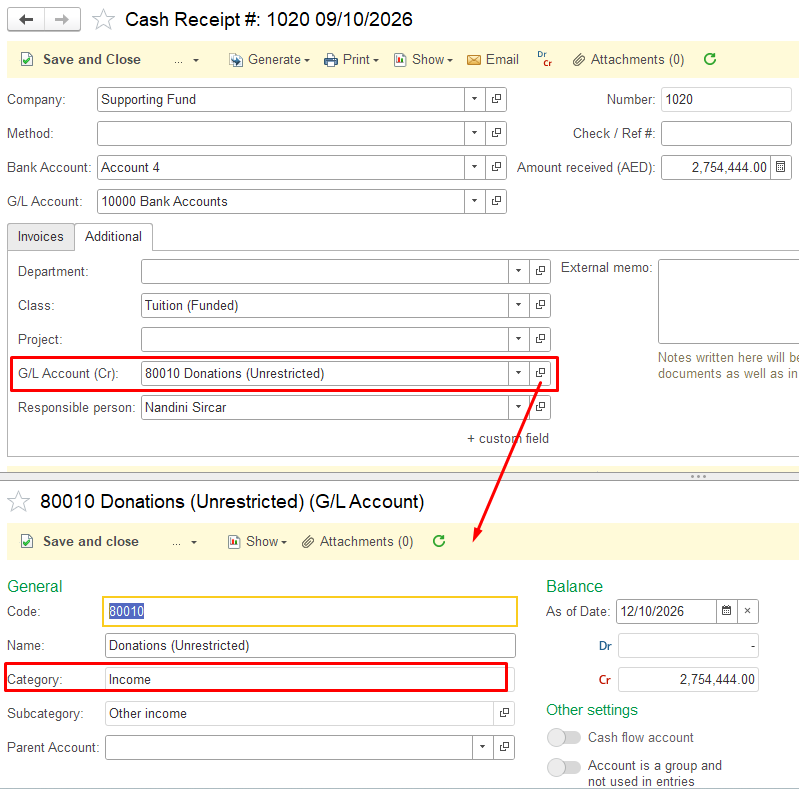
Unrestricted funds are contributions without donor-imposed limitations on their purpose or timing. The NGO can use them where they are most needed: for administration, staff, programs, equipment, or other operational needs. Use the Cash Receipt document to account for the Unrestricted income. Classes can be used as separator for every incoming cash amount.
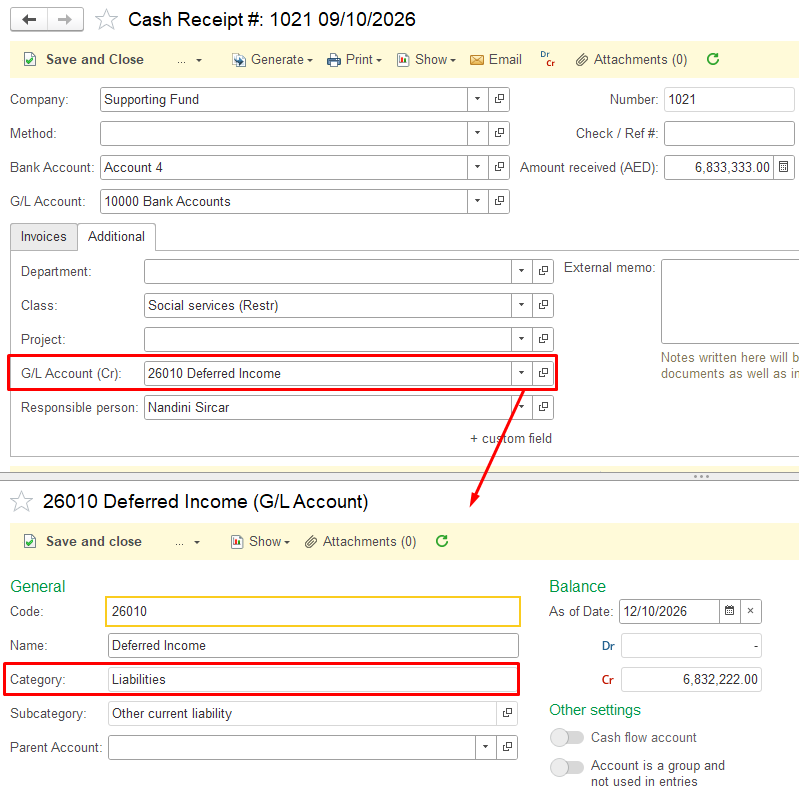
Restricted funds are contributions that a donor limits to a specific purpose, project, or period. The NGO must track these funds separately and use them only in line with the donor’s instructions. Use the Cash Receipt document to account for the Restricted income and select a credit account with the account type “Liability.” Classes can be used as separator for every incoming cash amount.
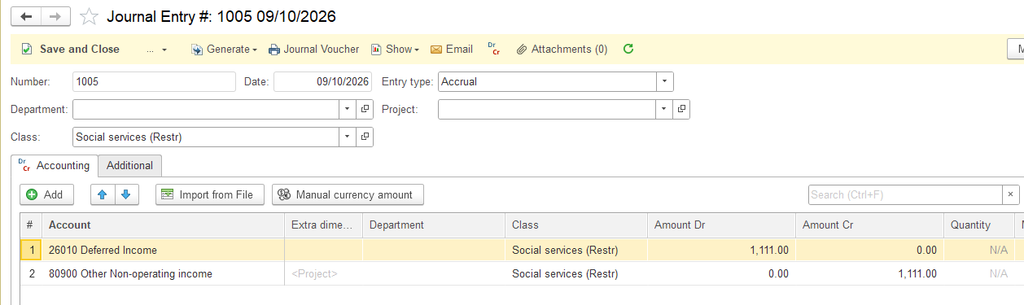
As soon as the requirements are met, the Deferred Income can be recognized as Income using the Journal Entry:
When Standard Features Are Not Enough: Customization and Integration #
AccountingSuite is designed to be extensible. If a specific requirement is not covered out of the box – such as a specialized front-office system for the clinic or school – you have two main paths:
1. Integration with Specialized Front-Office Software #
Many NGOs use industry-specific software for their programs (e.g., clinic management, school administration, microfinance tracking). AccountingSuite can integrate with these systems through:
- API connections (RESTful APIs for data exchange).
- CSV/Excel import/export for batch synchronization.
- Custom middleware developed as an extension.
2. Customization per Your Regulations #
For unique regulatory or operational needs, AccountingSuite supports customizations that can be developed as extensions. The official customization process ensures that your modifications remain compatible with future system updates.
Important: Customizations for cloud databases must be reviewed and approved by AccountingSuite administrators before deployment. For resource-intensive customizations, the on-premises version is recommended.
Learn more about the customization process: https://accountingsuite.io/help-support/customization/
Recommended Approach: Fit-Gap Analysis on Demo or Free Trial #
Before committing to a full implementation, we strongly recommend conducting a Fit-Gap Analysis using our demo database or a free cloud trial. This structured approach helps you:
- Document your requirements – List all must-have features for each activity (Foundation, School, Clinic, Microfinance, Coffee Shop) and for donor reporting.
- Test against AccountingSuite – Explore the demo database to see which requirements are met out of the box, which can be met through configuration, and which require customization or third-party integration.
- Identify gaps – For any gaps, determine whether they can be addressed through customization, integration, or a change in process.
- Make an informed decision – Decide what fits, what needs work, and what may not be feasible.
The Fit-Gap Analysis is Phase 0 of our implementation methodology. It ensures that client expectations and system capabilities are aligned early, reducing project risk and unexpected costs.
Start your Fit-Gap Analysis today:
- Explore the AccountingSuite demo database
- Request a free trial in the cloud
- Use our Implementation Steps guide to structure your evaluation.
Conclusion: One System for Every NGO Activity #
AccountingSuite is not just for for-profit businesses. Its flexible chart of accounts, configurable tax rules, project tracking, and extensible architecture make it a strong fit for NGOs with diverse activities. Whether you run a foundation, a school, a clinic, a microfinance scheme, a coffee shop, or all of the above, AccountingSuite can be configured to track funds by donor and project, monitor budgets, and produce both activity-specific and consolidated reports.
The key to success is a thorough Fit-Gap Analysis during the demo or trial phase. This allows you to see exactly how AccountingSuite meets your needs – out of the box, through configuration, or via customization – and to make a confident decision.
Ready to see how AccountingSuite works for your NGO?
Request a tailored demonstration or start your free cloud trial today.
For more information on implementation steps, visit our Implementation Steps documentation. For customization options, see our Customization page.
A Partner’s Guide to Demonstrating AccountingSuite to NGO Clients #
Introduction #
Non-governmental organizations (NGOs) and non-profit organizations (NPOs) represent a significant and growing market for AccountingSuite. Their accounting needs are unique: fund accounting, donor restrictions, grant tracking, functional expense classification, and multi-activity operations. While AccountingSuite is fully capable of meeting these requirements out of the box, a generic demonstration will fail to resonate with an NGO client.
This guide provides partners with a structured approach to preparing and delivering an effective, personalized demonstration of AccountingSuite to NGO prospects. The key principle is simple: show the client their own data, their own terminology, and their own operations — not a generic demo.
Step 1: Know Your Client – Research Before You Reach Out #
Before any demonstration or meeting, invest time in understanding your potential NGO client.
What to Research
| Source | What to Look For |
|---|---|
| Client’s website | Mission statement, programs, activities, annual reports, donor list, leadership team |
| Social media | Recent campaigns, events, donor engagement, program updates |
| Public filings | Annual reports, audited financial statements, tax-exempt status documents |
| News & press | Recent grants received, partnerships, expansions, new programs |
| Key staff, finance team structure, board members |
What to Request from the Client
Once initial contact is established, request the following information – the more you receive, the more effective your demonstration will be:
- Current automation system – What accounting software do they use today? What works? What doesn’t?
- Chart of Accounts – Their existing Chart of Accounts (CoA) structure (this is good for personalization).
- Product/item catalog – If they sell goods (e.g., a coffee shop, a school bookstore, a clinic pharmacy), get their item list.
- Typical transactions – Examples of routine entries: donor contributions, grant receipts, payroll, expense reports, program disbursements. Screenshots are ideal.
- Master data – Lists of:
- Donors and grantors
- Vendors/suppliers
- Employees
- Projects/programs
- Expense categories
- Departments or Cost Centers
- Founders/board members (for governance tracking)
- Critical automation needs – What must the system do to be worth switching? What is currently done manually that should be automated?
- Reporting requirements – Donor reports, board reports, regulatory filings, consolidated statements.
Tip: Even partial information is valuable. A CoA alone allows you to build a familiar environment for the client.
Step 2: Analyze What You’ve Collected #
Once you have the client’s information, analyze it systematically.
Use AI to Deepen Your Understanding
Ask your preferred AI chat tool questions like:
- “What are the typical accounting entries for an NGO receiving restricted and unrestricted donations?”
- “How are conditional grants recorded under US GAAP (FASB ASC 958) or IFRS?”
- “What are the functional expense categories for a non-profit?”
- “How does fund accounting work for an NGO with multiple programs?”
- “What are the accounting implications of an NGO operating a coffee shop or a clinic?”
- “How should biological assets (livestock) be accounted for under IAS 41?”
This research will help you:
- Understand the client’s pain points.
- Anticipate questions during the demonstration.
- Identify which AccountingSuite features are most relevant.
- Prepare accurate, industry-specific examples.
Map Client Needs to AccountingSuite Capabilities
Create a simple Fit-Gap analysis:
| Client Requirement | AccountingSuite Fit | How |
|---|---|---|
| Track restricted vs. unrestricted funds | ✅ Out of the box | Classes, custom fields, account segments |
| Donor-specific reporting | ✅ Out of the box | Project/Job Costing, custom reports |
| Grant budget vs. actual | ✅ Out of the box | Budgeting module, project tracking |
| Functional expense classification | ✅ Configuration | Expense accounts by function, class tracking |
| Multi-currency (foreign grants) | ✅ Out of the box | Multi-currency support |
| Livestock asset tracking | ✅ Asset Management | Fixed asset module, custom fields |
| Cheese production inventory | ✅ Configuration | Assembly/BOM, inventory module |
| Clinic patient billing | ⚠️ Integration needed | API or third-party front-office |
| School fee management | ⚠️ Integration needed | AR module + custom invoicing or integration |
For gaps, determine:
- Can it be solved with configuration? (No programming)
- Can it be solved with a third-party integration?
- Does it require custom development? If so, estimate hours and cost.
- Is the client willing to pay for it? If not, it may not be critical. If no ready-made solution exists on the market, AccountingSuite can always be integrated with Excel import for document data – a free, low-complexity workaround.
Key Insight: Many “gaps” can be closed by preparing Excel templates for data import. You can generate these templates using AI chat tools, asking for the correct format and fields. This satisfies client needs without complex customizations.
Step 3: Build a Prototype Database for the Demonstration #
This is the most important step for a successful NGO demonstration.
If the Client Provided Their Chart of Accounts
- Create a new database in AccountingSuite (Cloud demo or your partner On-premises sandbox).
- Import their Chart of Accounts directly.
- The client will see their own account structure – familiar, comfortable, and immediately engaging.
If the Client Provided Master Data
Import the following as master data:
- Items/Products – For coffee shop, clinic pharmacy, school bookstore, livestock (if tracked as inventory).
- Classes/Projects – For programs, grants, donor-funded projects.
- Expense Categories – For functional expense tracking.
- Departments – For school, clinic, foundation, microfinance, coffee shop.
- Counterparties – Donors, vendors, grantors.
- Founders/Board Members – For governance and related-party tracking.
If the Client Provided Nothing
Build your own master data based on:
- The standard AccountingSuite demo database.
- Information from the client’s website (program names, donor names, activity types).
- Industry norms for NGOs in their region.
Create master data that resembles what they likely use – donor names, program names, typical expense categories.
Why this matters: A demonstration on familiar data is exponentially more effective than a generic walkthrough. The client will see themselves in the system.
Use an AI chat to generate assumptions about the client.
Step 4: Prepare Typical NGO Transactions #
Prepare a set of sample transactions that demonstrate AccountingSuite can handle the client’s core operations at the Debit/Credit entry level.
Examples of Typical NGO Transactions
| Transaction | Debit | Credit |
|---|---|---|
| Unrestricted donation received | Cash/Bank | Contribution Revenue (Unrestricted) |
| Restricted donation received | Cash/Bank | Contribution Revenue (Restricted) |
| Grant received with condition | Cash/Bank | Refundable Advance (Liability) |
| Condition met, grant recognized | Refundable Advance | Grant Revenue |
| Program expense (restricted fund) | Program Expense | Cash/Bank |
| Payroll for program staff | Salaries Expense | Cash/Bank, Payroll Liabilities |
| Purchase of livestock (fixed asset) | Livestock Asset | Cash/Bank |
| Milk harvest (agricultural produce) | Inventory (Milk) | Agricultural Produce Revenue |
| Cheese production (milk to cheese) | Inventory (Cheese) | Inventory (Milk) + Conversion Costs |
| Coffee shop sale | Cash/Bank | Sales Revenue |
| Cost of goods sold (coffee) | COGS | Inventory |
| Employee loan disbursement | Loans Receivable | Cash/Bank |
| Employee loan repayment | Cash/Bank | Loans Receivable + Interest Income |
| School tuition fee received | Cash/Bank | Tuition Revenue |
| Clinic service revenue | Cash/Bank | Patient Service Revenue |
Prepare these transactions in your prototype database so you can show the full cycle: entry → posting → reporting.
Step 5: Identify Special Requirements – Customizations and Integrations #
If the client has specific needs not covered by standard AccountingSuite features:
1. Research the Specifics
Use AI chat to explore:
- Regulatory requirements in their jurisdiction.
- Industry-specific accounting standards (e.g., IAS 41 for agriculture, ASC 958 for US nonprofits).
- Common software integrations for their sector (e.g., clinic management, school administration, farm management).
2. Hypothesize Required Customizations
For each gap, outline:
- What needs to be developed (e.g., a custom report, an API integration, a workflow automation).
- How it would be developed (extension, external report, third-party connector).
- Estimated effort in person-hours.
- Estimated budget for development, separate from AccountingSuite licenses.
3. Assess Client Willingness to Pay
Ask yourself:
- Is this customization critical to their operations?
- Are they willing to pay for it?
- If not, is it truly important? If they won’t pay, it may not be a priority.
- Are there ready-made solutions on the market? If not, AccountingSuite can often bridge the gap with Excel import – a free, simple workaround.
Remember: AccountingSuite can always be integrated with Excel for importing data into documents. You can generate the required Excel templates using AI chat tools, asking for the correct field structure and format. This closes many needs without complex development.
4. Document and Present
Include in your proposal:
- Standard features (out of the box).
- Configuration options (no programming).
- Recommended customizations (with cost/benefit).
- Excel-based workarounds (free, low-effort).
Step 6: You Are Ready to Demonstrate #
With preparation complete, you are ready to deliver a compelling, personalized demonstration.
Demonstration Best Practices
- Start with their data – Show their Chart of Accounts, their donors, their programs.
- Walk through a typical day – From donation receipt to program disbursement to donor report.
- Show the full cycle – Entry → Posting → Financial Statements → Donor Reports.
- Demonstrate fund accounting – Show restricted vs. unrestricted tracking.
- Show multi-activity consolidation – Foundation, School, Clinic, Microfinance, Coffee Shop — all in one system, with separate and consolidated reports.
- Address their pain points – Reference the specific challenges they mentioned.
- Be honest about gaps – If something requires customization, explain the path, cost, and timeline. Offer Excel-based workarounds where applicable.
- End with next steps – Fit-Gap Analysis on demo/trial, proposal, timeline.
What NOT to Do
- ❌ Do not show a generic demo – It will not resonate. The client will not see themselves in the system.
- ❌ Do not focus only on features – Focus on solving their problems.
- ❌ Do not overpromise – Be clear about what is standard, what is configurable, and what requires custom development.
- ❌ Do not ignore their current system – Acknowledge what they use today and how AccountingSuite improves upon it.
Key Takeaways for Partners #
| Principle | Action |
|---|---|
| Know your client | Research their website, request their CoA, master data, and typical transactions. |
| Personalize the demo | Build a prototype with their data – familiar data is powerful. |
| Prepare typical transactions | Show Debit/Credit entries for their core operations. |
| Analyze gaps with AI | Use AI chat to understand industry specifics and hypothesize customizations. |
| Estimate customization costs | Provide effort and budget estimates; assess client willingness to pay. |
| Offer Excel workarounds | For non-critical gaps, Excel import is a free, effective solution. |
| Demonstrate with confidence | A prepared, personalized demo showcases AccountingSuite’s true strengths for NGOs. |
Conclusion for Partners #
AccountingSuite is an excellent fit for NGOs. It handles fund accounting, donor restrictions, grant tracking, functional expenses, multi-currency, and multi-activity operations – all out of the box or with simple configuration.
But the system sells itself only when the client sees it working with their own data.
A little preparation – researching the client, importing their CoA, building familiar master data, preparing typical transactions – transforms a generic software demo into a compelling, personalized presentation. The client sees their own programs, their own donors, their own challenges – and how AccountingSuite solves them.
Remember: AccountingSuite is not just for for-profit businesses. It is a powerful, flexible platform for NGOs of all types and sizes. With the right preparation, you will demonstrate exactly that.