
The Exchange Difference Report provides a comprehensive analytical overview of transactions executed in foreign currencies, focusing on the identification of discrepancies between the expected and actual exchange rates applied during posting. Its primary purpose is to offer detailed insight into the origin and structure of exchange differences, and to classify them into income and expenses, thereby ensuring the accuracy of financial reporting and enabling transparent insight into the impact of exchange rate fluctuations on business operations.
Navigate to Accounting → Accounting Reports → Exchange Difference Report
Through its clearly structured columns, the report answers the following key questions:
- What is the source of the Exchange difference? – By comparing the expected and actual exchange rates, the report identifies the cause of the exchange difference.
- What is the financial effect? – It precisely separates positive effects (income) from negative effects (expenses) arising from exchange rate fluctuations.
- What does the transaction refer to? – Through additional dimensions (class, G/L account), it enables analysis of exchange differences across various Ext. dimensions (customers and vendors).
- What is the overall impact on the financial result? – It summarizes all income and expenses from exchange differences within the observed period.
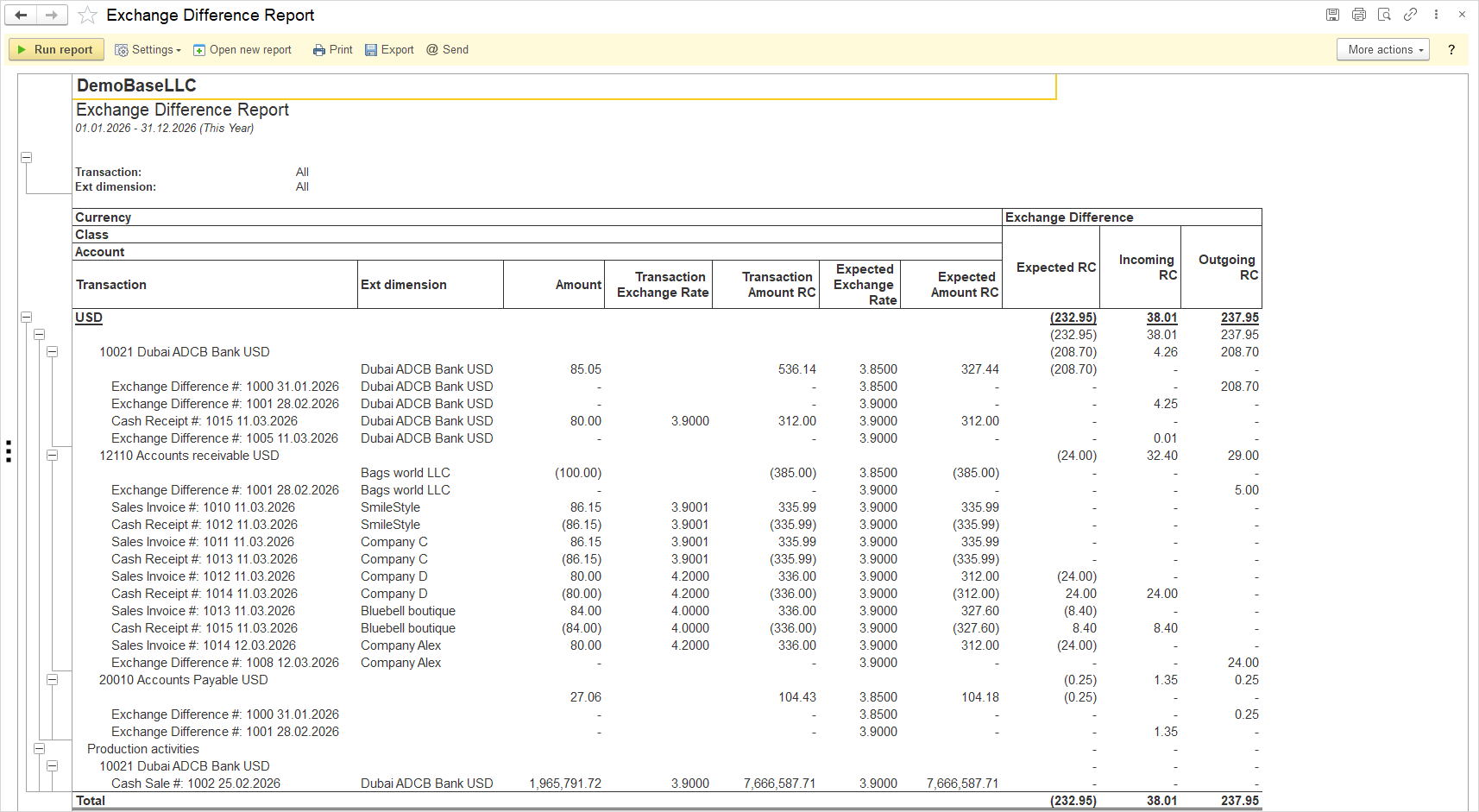
Breaking Down the Columns:
- Currency: display the currency of the transaction. (see Currencies)
- Class: extra category, branch (see Classes)
- Account: specifies which G/L account was affected. (see Account)
- Transaction is a document with that amount.
- Ext dimension is an additional analytical field used for classifying transactions by partner, project, or other custom criteria.
- Amount is the numerical value of a transaction expressed in the original foreign currency.
- Transaction Exchange Rate is the rate taken from the source document (Bill, Sales Invoice and etc.) applied when posting the transaction to the general ledger.
- Transaction Amount RC is the value of the transaction converted into the reporting currency using the actual transaction exchange rate.
- Expected Exchange Rate is the reference rate used for comparison, as defined in the Currencies setup.
- Expected Amount RC represents the estimated value of a transaction in the reporting currency, calculated using the predefined exchange rate.
- Exchange Difference:
- Expected RC displays the expected amount in reporting currency as a reference point for allocation.
- Incoming RC: (debit) increase the account balance with actual Exchange Difference amount in reporting currency.
- Outgoing RC (credit) decrease the account balance with actual Exchange Difference amount in reporting currency.